Quick Answer
A franchise buildout in Chicago and the surrounding suburbs typically takes 9 to 14 months from site approval to grand opening. Actual construction accounts for only about 10 to 16 weeks of that. The rest is lease negotiation, franchisor design approval, permitting, utility work, equipment procurement, and licensing. The three items that most often destroy a franchise schedule are health department plan approval, which Chicago requires before construction begins rather than after, utility service upgrades when the space was not previously a food use, and liquor licensing, which runs on its own clock entirely.
Every franchisee we work with arrives with a date in mind. The franchisor wants the unit open by a certain quarter. The lease has a rent commencement clause. Somebody has already booked a grand opening.
Then the schedule meets reality, and the gap between the two is almost never construction. It is everything that has to happen before a single wall goes up, and everything that has to happen after the last one is finished.
Here is the honest phase-by-phase timeline, with the Chicago-specific requirements that catch people who have built franchises in other markets.
Phase 1: Site Approval and Lease Execution, 4 to 8 Weeks
Your franchisor approves the site. That is the starting gun, not the finish line.
Between site approval and a signed lease, several things have to happen in parallel: lease negotiation, a work letter defining who builds what, a tenant improvement allowance discussion, and ideally a feasibility walk with your contractor before you sign anything.
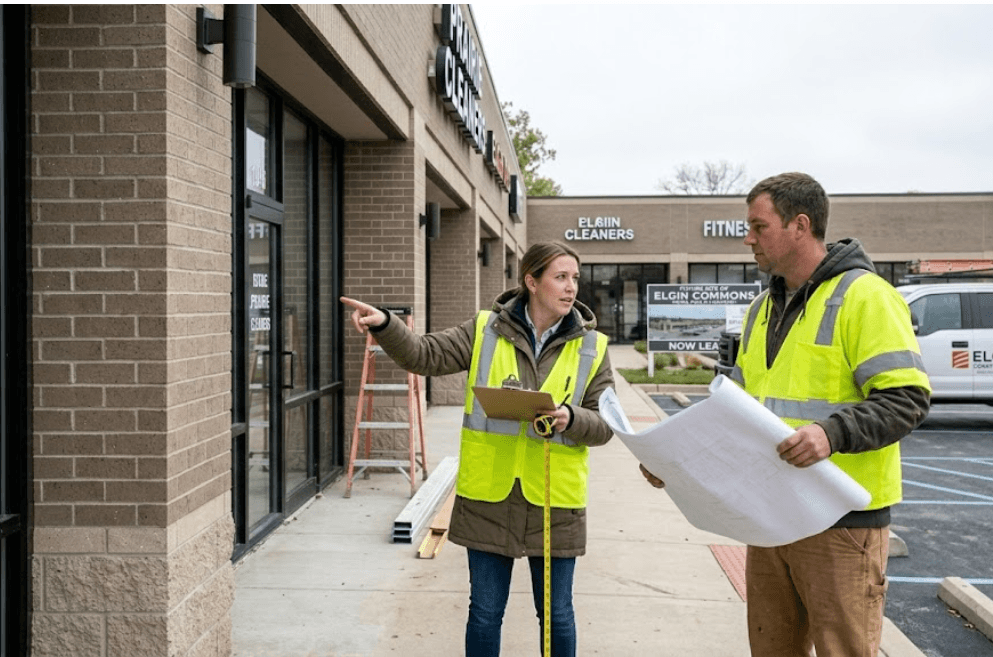
That last one is the step people skip, and it is the cheapest insurance in the entire project. A contractor walking the space can tell you within an hour whether the electrical service is adequate, whether there is grease waste capacity, whether the ceiling height supports your hood, and whether the existing restrooms are ADA compliant. Discovering any of those after signing turns a negotiating position into a bill.
We covered the full pre-signing review in our commercial lease build-out checklist.
Phase 2: Franchisor Design Package and Local Architecture, 6 to 10 Weeks
Franchise brands supply a prototype design package. It is not a permit set.
The prototype tells you the layout, the equipment schedule, the finishes, the signage, and the brand standards you cannot change. What it does not do is comply with Chicago or your village’s specific code requirements, account for your actual building’s structure, or carry an Illinois architect’s seal.
So a local architect adapts the prototype into a permit set. That adaptation is where most of the six to ten weeks goes, and it involves a loop back to the franchisor for approval of any deviation. If your space has a column in the wrong place, or the ceiling will not take the prototype’s lighting grid, that becomes a variance request to the brand, and brands do not turn those around quickly.
Start this the day the lease is signed. Every week of delay here moves the opening date one for one.
Phase 3: Permitting and Plan Review, 8 to 16 Weeks
This is where Chicago differs sharply from most markets, and where out-of-state franchisees get hurt.
The health department requirement that comes first
Chicago Municipal Code 7-38-035 states that no new food establishment shall be constructed, and no major alteration or replacement of equipment affecting sanitary requirements shall be permitted, unless plans and complete drawings are submitted to the department of health and approved prior to that construction.
Read that again. Approval before construction, not an inspection afterward. The Chicago Department of Public Health plan review is coordinated with the Department of Buildings during the building permit application process, so it is not a separate errand you run later. It is a gate.
Franchisees who assume the health department shows up at the end, the way it works in many suburbs and other states, discover the problem after they have already built something that now has to be modified.
Building permits
Chicago runs two tracks. Simpler scopes that need no architectural plans can move through the expedited permit path. Anything structural, or anything with significant mechanical, electrical, and plumbing work, goes through standard plan review with a full drawing set. A franchise buildout with a commercial kitchen is always the second track.
Chicago also requires licensed electricians and licensed plumbers to pull permits under their own licenses for their portion of the work. A general contractor cannot file those on their behalf, which means your trades have to be selected before permitting, not after.
Plan review comments are the hidden variable. An unanswered comment leaves your application sitting while your rent clock runs. Somebody has to be watching that submission daily.
Zoning and signage
Signage is its own permit and its own review, and franchise signage is frequently larger or more illuminated than a local code allows. In some suburbs it requires a variance, which means a public meeting, which means a calendar you do not control. Start the sign package with the building permit, never after.
Phase 4: Long Lead Procurement, Starts Immediately and Runs 12 to 65 Weeks
This phase does not follow the others. It runs underneath all of them, and if it starts late, nothing else matters.
Electrical service
Here is the one that has become genuinely dangerous to schedules. If your unit needs a new or upgraded utility transformer, procurement data published by Terrapin Construction Group in June 2026 put pad-mount transformers at 40 to 65 weeks against a historical baseline of about 8 weeks.
That is not a rounding error. That is the difference between opening this year and opening next year.
When does this apply? Most often when a quick service restaurant moves into a space that used to be retail. A clothing store and a fryer-heavy kitchen are not remotely comparable electrical loads. If the previous tenant was not a food use, assume a service upgrade until an electrician tells you otherwise, and get that determination during the lease walk in Phase 1.
Kitchen equipment and refrigeration
Walk-in coolers and freezers are built to order. Exhaust hoods are fabricated to your specific layout. Both routinely run 10 to 20 weeks, and both are required before you can pass a health inspection.
Brand millwork and fixtures
Franchise brands often require millwork from an approved vendor, and those vendors serve every franchisee in the system simultaneously. During a national rollout, your counter package waits in the same queue as everyone else’s.
The rule: order long lead items off the approved drawings, not the permitted drawings. Waiting for a permit to place orders adds two to four months for no benefit. Anything unlikely to change in plan review should be ordered as soon as the franchisor signs off.
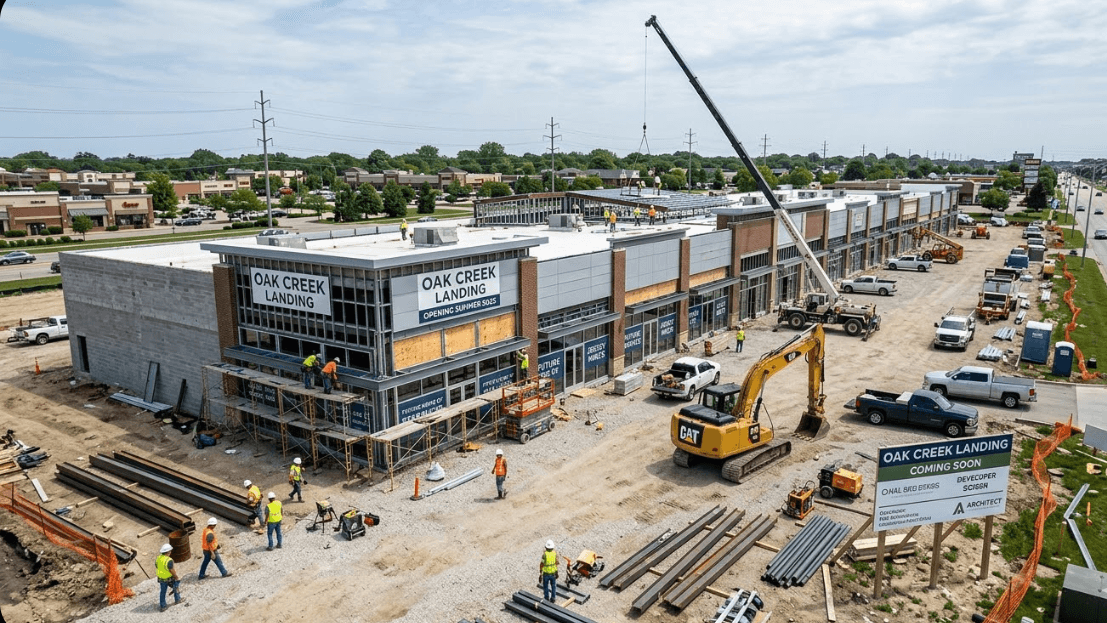
Phase 5: Construction, 10 to 16 Weeks
The part everyone thinks of as the project is the shortest phase in it.
For a typical inline franchise unit of 1,500 to 3,000 square feet, the sequence runs: demolition, then framing, then rough mechanical, electrical, and plumbing, then rough inspections, then insulation and drywall, then flooring, then millwork and fixtures, then equipment set and final connections, then finishes and paint, then final inspections.
Each stage gates the next. That is why a mid-project change costs more schedule than the change itself takes to perform. If you swap a piece of equipment after the rough-in is inspected, you are not just moving a connection, you are reopening a wall, rescheduling a trade, and requesting a re-inspection.
Ground-up pad construction is a different animal, adding site work, foundations, shell, and roof. Budget 6 to 9 months for construction alone on a freestanding building, plus the site development approvals that come before it. Our comparison of build-out versus ground-up construction breaks down both paths.
Phase 6: Inspections, Licensing, and Opening, 3 to 6 Weeks
Construction being finished does not mean you can open. You need a certificate of occupancy and your operating licenses, and in Chicago the licensing sequence has a specific trigger most people do not know about.
For a food concept, your Retail Food Establishment License application payment is what triggers the Chicago Department of Public Health inspection. The city’s own guidance is direct about the timing: payment should be made 3 to 4 weeks prior to your target opening date, all required building permits should be obtained, and all work should be completed. A CDPH sanitarian then contacts you and the on-site inspection is conducted within 3 to 5 days after CDPH receives the license assignment.
So the inspection moves fast once triggered. The mistake is triggering it before the space is genuinely ready, or triggering it too late to leave room for a re-inspection if something fails.
Two more things worth knowing. A debt check runs as part of the application, and all city debt has to be resolved before the license issues. And City of Chicago business licenses are non-transferable, so each location needs its own even if you already operate three others.
The liquor license runs on a separate clock
If your concept serves alcohol, this is a parallel track you start early and manage independently. The city’s Restaurant Start-Up Guide puts the application process at 60 to 120 days, and it involves facility inspection and background review. Some locations also carry additional requirements depending on the ward and the specific address.
Start it at lease signing. Not at construction completion. We have watched finished restaurants sit dark for six weeks waiting on this one item.
The Five Things That Actually Blow Franchise Schedules
After twenty years of these, the pattern is consistent.
1. Late franchisor approval of a deviation. Something in your space does not match the prototype. The variance request sits at corporate for three weeks. Everything downstream waits.
2. A utility service upgrade nobody scoped. Discovered after lease signing, with a transformer lead time measured in quarters.
3. Health department plan review treated as a final inspection. In Chicago it is a precondition of construction. Getting this backward means rework.
4. Long lead items ordered after permit issuance. Adds two to four months of pure waiting for no gain.
5. Liquor licensing started at the end. A completed restaurant that legally cannot open is the most expensive possible outcome, because rent and payroll have already started.
Note that four of the five are sequencing problems, not construction problems. That is the whole point of this article.
How the Timeline Changes by Space Type
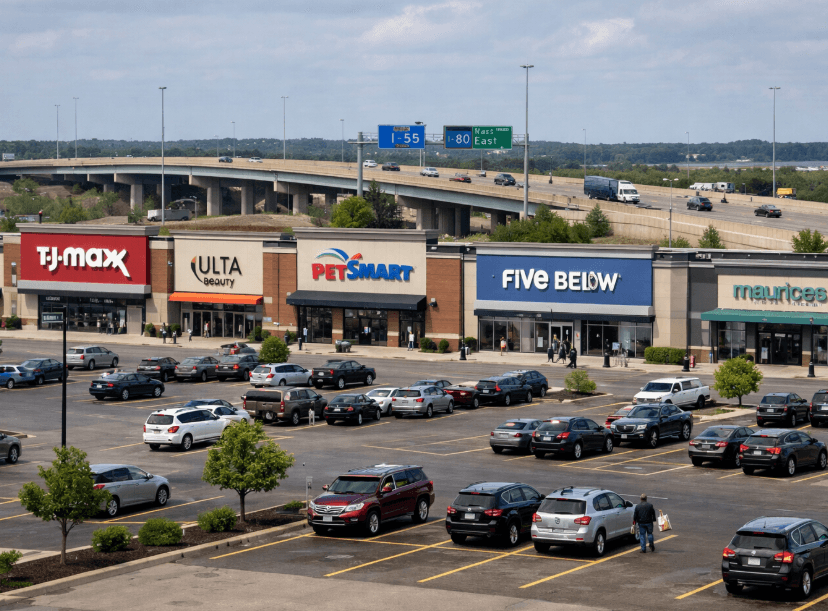
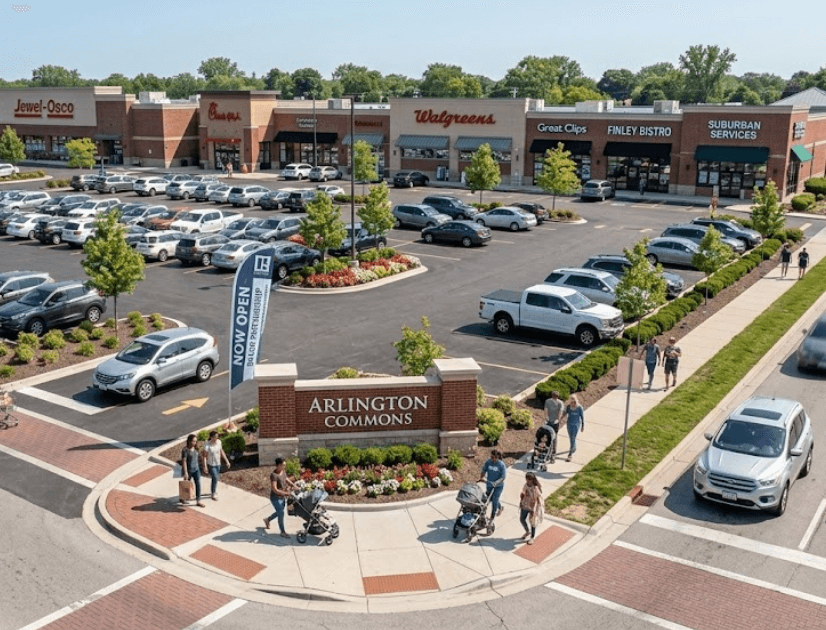
Inline unit in an existing plaza, second-generation food space. Fastest path. The grease waste, the hood infrastructure, and the electrical service may already exist. 7 to 10 months is realistic.
Inline unit, first-generation or former non-food use. Add the service upgrade risk, the grease interceptor, and the hood and makeup air work. 9 to 14 months.
End cap with a drive-thru. The drive-thru is a zoning question before it is a construction question, and in many Chicagoland municipalities it requires a special use approval with a public hearing. Add 2 to 4 months to the front of the schedule and treat that approval as the real start date.
Ground-up pad site. Site plan approval, engineering, stormwater, and utility extension all precede vertical construction. 14 to 24 months total is normal.
Chicago Versus the Suburbs
Chicago has more layered requirements, but they are at least consistent and documented. You know what the process is.
The suburbs vary enormously village by village. Some have a streamlined commercial review and a building department that will meet with your architect before submittal. Others meet on a fixed monthly schedule, which means a single round of comments can cost you thirty days. Some require a pre-application conference. Some hand off health review to the Cook, DuPage, or Will County health department rather than a city agency.
None of that is a reason to prefer one over the other. It is a reason to find out the specific process for your specific municipality before you commit to an opening date. We build across Chicago and more than twenty five suburbs and file under each one’s own rules rather than assuming city procedures apply.
How to Actually Compress the Schedule
Things that work:
- Walk the space with your contractor before signing the lease
- Engage the local architect the day the lease executes
- Order long lead equipment off franchisor-approved drawings, not permitted drawings
- Submit the health department plan review with the building permit application, not after
- File the liquor license application at lease signing
- Assign one person to monitor plan review comments daily
- Select your licensed electrical and plumbing trades before permitting, since they file their own permits
- Lock every finish selection before demolition
Things that do not work: adding crew to a project that is waiting on a permit, or on a transformer, or on a license. You cannot staff your way out of a sequencing problem, and trying to is how budgets get spent without the date moving.
Frequently Asked Questions
How long does a franchise buildout take from start to finish?
In Chicago and the surrounding suburbs, a franchise buildout typically takes 9 to 14 months from site approval to grand opening. Construction itself accounts for only about 10 to 16 weeks of that for a standard inline unit. The remaining time goes to lease negotiation, franchisor design approval, local architecture, permitting and plan review, equipment procurement, and licensing. A ground-up pad site runs considerably longer, typically 14 to 24 months.
Why is construction such a small part of the franchise timeline?
Because most of the schedule is approvals and procurement rather than labor. Before anyone can build, you need a signed lease, a franchisor-approved design adapted into a sealed local permit set, building permits through plan review, and in Chicago a health department plan approval. After construction finishes, you still need final inspections, a certificate of occupancy, and operating licenses. Four of the five most common causes of franchise delays are sequencing problems, not construction problems.
Does Chicago require health department approval before construction?
Yes. Chicago Municipal Code 7-38-035 states that no new food establishment shall be constructed, and no major alteration or replacement of equipment affecting sanitary requirements shall be permitted, unless plans and complete drawings are submitted to the department of health and approved prior to that construction. The Chicago Department of Public Health plan review is coordinated with the Department of Buildings during the building permit application process. Franchisees who assume health review happens as a final inspection often end up rebuilding work that was already completed.
When does the Chicago health inspection happen for a new restaurant?
Payment of your Retail Food Establishment License application triggers the on-site Chicago Department of Public Health inspection. City guidance directs applicants to make that payment 3 to 4 weeks prior to the target opening date, with all required building permits obtained and all work completed. A CDPH sanitarian then contacts the applicant and conducts the on-site inspection within 3 to 5 days after CDPH receives the license assignment. Triggering the inspection before the space is genuinely ready leaves no room for a re-inspection.
How long does a liquor license take in Chicago?
The City of Chicago Restaurant Start-Up Guide puts the application process at 60 to 120 days, and it involves a facility inspection and background review. Because it runs on its own clock independent of construction, it should be started at lease signing rather than when the build is finished. A completed restaurant that cannot legally open is the most expensive delay in the project, since rent and payroll have already begun.
What is the longest lead time item in a franchise buildout?
Usually electrical. If your unit requires a new or upgraded utility transformer, procurement data published by Terrapin Construction Group in June 2026 put pad-mount transformers at 40 to 65 weeks against a historical baseline of about 8 weeks. This most often applies when a quick service restaurant moves into a space previously occupied by a non-food use, since the electrical loads are not comparable. Walk-in coolers and exhaust hoods are also built to order and typically run 10 to 20 weeks.
When should I order equipment for a franchise buildout?
Order long lead items off the franchisor-approved drawings rather than waiting for permitted drawings. Waiting for permit issuance to place orders adds two to four months to the schedule for no benefit, because most equipment selections do not change during plan review. Anything unlikely to be affected by reviewer comments should be ordered as soon as the franchisor signs off on the design.
Do I need a separate license for each franchise location in Chicago?
Yes. City of Chicago business licenses are non-transferable, so each restaurant and each location must have its own license in order to operate, even if you already operate other units in the city. A debt check is also conducted as part of the application process, and all city debt must be resolved before the license will issue.
How does a drive-thru change the franchise construction timeline?
A drive-thru is a zoning question before it is a construction question. In many Chicagoland municipalities it requires special use approval with a public hearing, which runs on the municipality’s meeting calendar rather than yours. Add roughly 2 to 4 months to the front of the schedule and treat that approval, not the lease, as the real start date for everything downstream.
Planning a Franchise Buildout in Chicagoland
The franchisees who open on time are not the ones with the fastest crews. They are the ones who started the slow items first.
Horizon Construction Team handles franchise and chain construction, restaurant and cafe construction, and retail shop construction across Chicago and the suburbs, from pre-construction feasibility through final inspection. We walk spaces with franchisees before they sign, so the schedule is built on what is actually behind the walls.
Before you commit to an opening date, read our guide to the hidden costs of retail construction and our commercial lease build-out checklist.
Call (773) 858-3214 or request a free quote. Offices at 211 W Wacker Drive, Suite 324, Chicago, IL 60606.
Sources: Chicago Municipal Code 7-38-035 on submittal of plans and drawings to the department of health. Chicago Department of Public Health Retail Food Establishment license inspection guidance. City of Chicago Restaurant Start-Up Guide, liquor license processing. City of Chicago business licensing requirements. Terrapin Construction Group equipment procurement data, June 2026.